







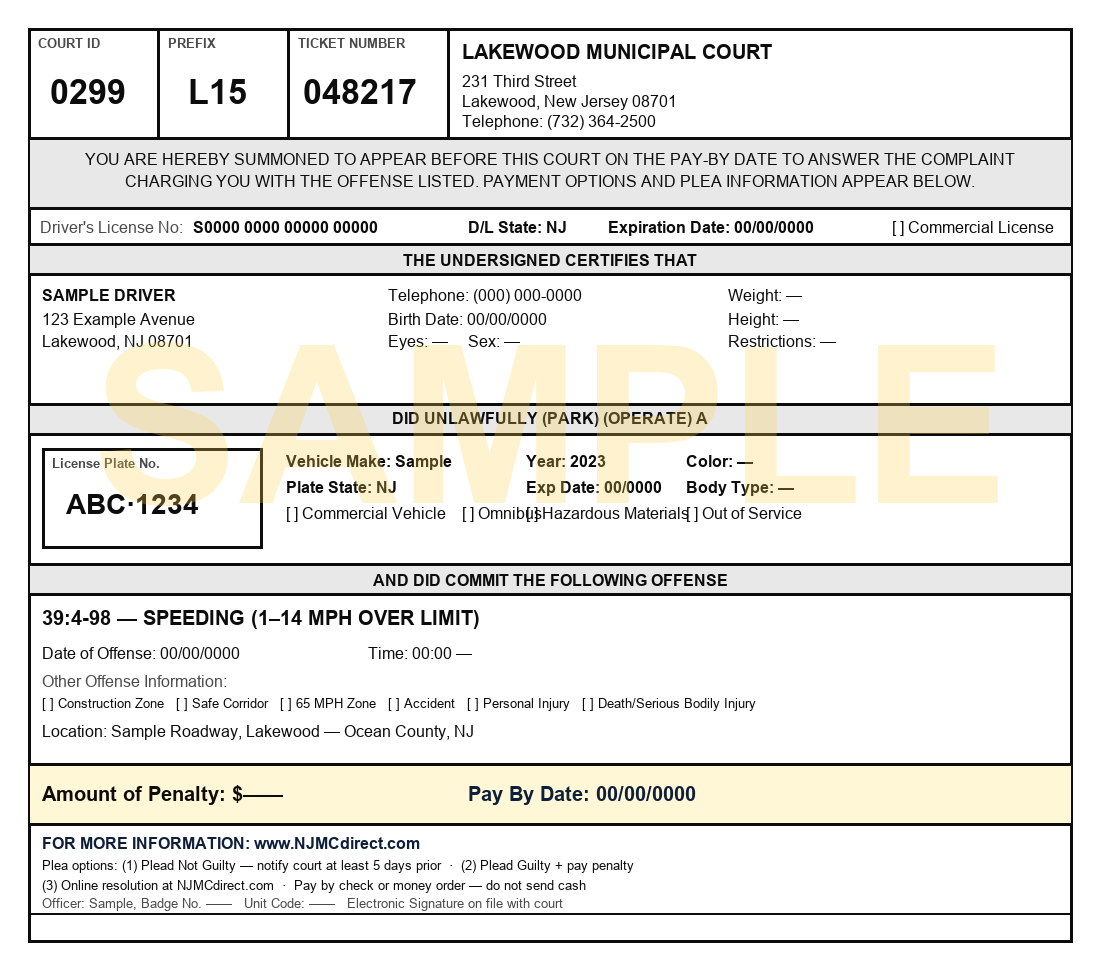
NJ Stop Sign Ticket — N.J.S.A. 39:4-144
A stop sign violation in New Jersey is a 2-point moving violation that follows you on your insurance for three years and quietly costs more than the fine. Goldman Law Firm defends NJ stop sign tickets at municipal courts statewide. Free consultation 24/7. Call 908-692-7745.
NJ Stop Sign Law — N.J.S.A. 39:4-144
The statute requires every driver approaching a stop sign or yield sign to come to a full stop (at a stop sign) or yield (at a yield sign) before entering the intersection. Penalties:
- First offense: $50–$200 fine, 2 points on your license.
- Insurance impact: typically 15–30% premium increase, sustained 3 years.
- Mandatory court costs: roughly $33 added to the base fine.
How Stop Sign Tickets Get Issued
- Rolling stop. The most common factual basis — the officer observed slowing but not a full stop. NJ requires a complete cessation of motion behind the stop line.
- Failure to yield right of way. Drivers who stop but then enter the intersection unsafely are often cited.
- Post-accident citation. Crashes at controlled intersections frequently produce a stop-sign ticket for one driver.
How We Defend NJ Stop Sign Tickets
- Officer observation challenges. “Rolling stop” determinations require a clear view of the stop line and the vehicle’s wheels. Cross-examination on angle, distance, and obstruction frequently weakens the State’s case.
- Sign visibility. If the stop sign was obscured by foliage, weather, or other obstructions — or if it had been recently installed — the case is defensible. Some intersections have known visibility complaints documented with local traffic engineering.
- Plea downgrade. Standard outcome: a plea to an unsafe-operation charge (39:4-97.2) — same fine, no points, no insurance hit.
- Constitutional stop. If the officer’s reason for the stop wasn’t legally valid, suppression is on the table.
NJ Stop Sign Ticket — Frequently Asked Questions
What counts as a “complete stop” in NJ?
The vehicle must come to a full cessation of motion behind the stop line (or, if no line, before the crosswalk or intersection). Any forward motion through the stop is technically a rolling stop and grounds for a ticket — though most officers exercise some discretion.
Should I just pay the stop sign ticket?
Only if you’re willing to absorb the 2 points and 3 years of insurance increase that follow. For most drivers the math heavily favors fighting — a no-point downgrade typically costs less than one year of insurance impact.
Can a stop sign ticket be dismissed?
Outright dismissal is possible — typically when the officer doesn’t appear, when sign visibility is an issue, or when the State can’t establish key elements. More often we negotiate a no-point downgrade. Either result protects your insurance record.
How much does a NJ stop sign ticket lawyer cost?
Flat fee, quoted upfront after a free consultation. The fee is typically a fraction of your insurance increase if you plead guilty. Call 908-692-7745.