







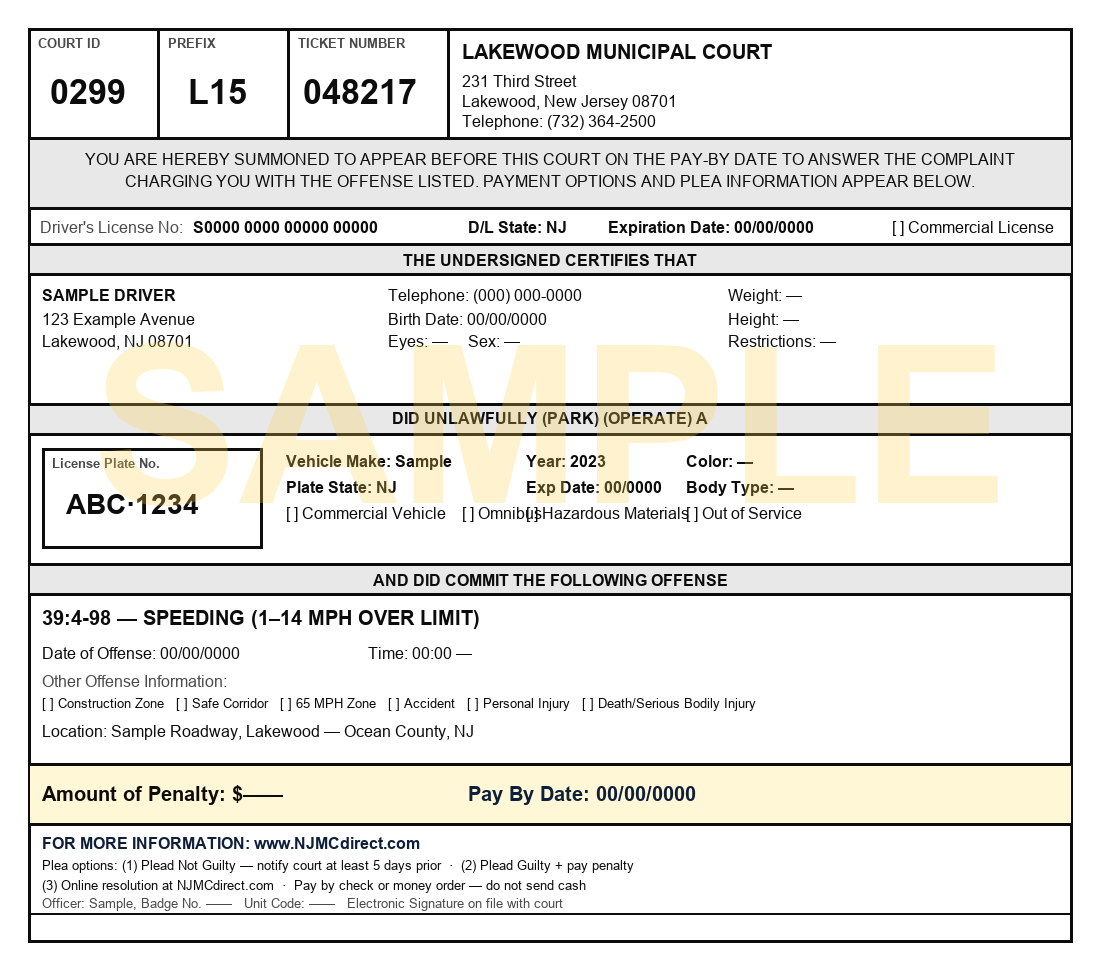
Cited Under N.J.S.A. 39:6B-2? This Is the Ticket You Do Not Just Pay
Of all the tickets a New Jersey driver can pick up at a routine stop, driving without insurance is the one most worth fighting — because it punishes harder than almost any moving violation while carrying zero points, which lulls people into treating it like paperwork. It is not paperwork. A first conviction under N.J.S.A. 39:6B-2 brings a court-set fine, possible community service, a license suspension of up to a year on the table, and — the part nobody warns you about — MVC insurance surcharges billed annually for three years on top of everything the court does. Goldman Law Firm defends 39:6B-2 charges in municipal courts throughout New Jersey. The consultation is free, 24/7: call or text 908-692-7745, or start with a free ticket review — snap a photo of the summons and we’ll tell you what you’re actually facing.
What a No-Insurance Conviction Actually Carries
New Jersey requires liability coverage on every registered vehicle, and 39:6B-2 is how the State enforces it. Here is the honest picture of a conviction. First offense: a fine set by the court, community service the court can order, and a license suspension — for years suspension was automatic, and while judges now have discretion, up to a year of your license is squarely at stake. Second offense: the statute stops being flexible — mandatory jail time (14 days), 30 days of community service, and a two-year license suspension. And separate from anything the judge does, the MVC bills an insurance surcharge every year for three years after a no-insurance conviction — miss those bills and your license is suspended again for non-payment. Our NJ surcharge guide explains how that system works. Add it up and a “no-points ticket” quietly outpunishes a 4-point speeding conviction — which is exactly why pleading guilty by default is a mistake.
The Most Beatable Version: the Car Was Actually Insured
A surprising share of 39:6B-2 charges are written against vehicles that had coverage. The driver couldn’t find the current insurance card, the app wouldn’t load on the shoulder of Route 9, the policy renewed the week before and the paperwork lagged — and the summons got written anyway. If there was a policy in force at the moment of the stop, documenting that is usually the whole case: we obtain the declarations page and payment history and put the proof in front of the court. Not having the card on you is its own minor violation — it is not driving uninsured, and we push for the case to be treated for what it actually was.
Borrowed Car? You Are Not Automatically Guilty
39:6B-2 reaches an owner who drives or lets others drive an uninsured vehicle — but if you borrowed someone else’s car and had every reason to believe it was insured, the law does not treat you like the owner who let the policy lapse. Courts look at what a borrower actually knew or had cause to know. This defense matters constantly in the real world: the friend’s car, the girlfriend’s car, the work van an employee was handed with the keys. If you were driving someone else’s uninsured vehicle in good faith, say so at the consultation — it changes the entire posture of the case.
Lapsed Policies and the Fine Print
The next-biggest bucket is the lapse: an autopay card expired, a payment posted late, the insurer non-renewed and the notice went to an old address. Two things matter here. First, what the insurer’s records actually show — reinstatements are sometimes backdated, grace periods apply in some situations, and cancellation itself has notice requirements the carrier must have followed. We pull the policy history and check. Second, how quickly coverage was restored. Coming to court with an active policy in hand does not erase the charge, but a cured, short, good-faith lapse is a very different negotiation than an uninsured car on the road for a year — and the resolution should reflect that difference.
Expect a Court Date, Not a Checkbox
Most tickets in New Jersey can be paid online, which is how people accidentally convict themselves. A no-insurance charge generally is not one of them — expect a mandatory appearance in the municipal court of the town where you were stopped. That court date is not a formality; it is the venue where this charge gets beaten, amended, or mishandled. Walking in without counsel and pleading guilty “to get it over with” locks in the suspension exposure and starts the three-year surcharge clock. Walking in with proof of coverage, a documented innocent-borrower story, or a cured lapse and a negotiation plan is a different day entirely.
How We Defend a 39:6B-2 Charge
Proving coverage was in force
Declarations pages, payment records, carrier letters — if the vehicle was insured at the time of the stop, we assemble the proof and press for the charge to fall away or be treated as the paperwork violation it really was.
The innocent-driver defense
Where you were not the owner and had no reason to know the car was uninsured, we build that record: whose car it was, what you were told, what the circumstances showed. The State’s case assumes knowledge the law does not automatically give it.
Holding the State to its proofs
The State has to prove the vehicle was uninsured and that you operated it — or owned it and permitted its use — not merely that no card was produced at the window. We review the stop, the officer’s report, and what the insurance databases actually said, and charges built on a records error are challenged as exactly that.
Negotiating the resolution that costs you least
Where the proofs are solid, the work shifts to damage control done right: a resolution at the lowest available level, suspension exposure fought hard — keeping you legal to drive to work is usually the client’s real bottom line — and an outcome that accounts for the surcharge math, not just the fine. We are straight with you about what is realistic before you spend anything.
The Charges That Travel Together
No-insurance rarely rides alone. The same stop often produces driving while suspended (39:3-40) or driving without a license (39:3-10) — and unresolved surcharges from an old no-insurance case are one of the most common reasons a license was suspended in the first place, a loop that keeps drivers cited over and over. If your summons stack has more than one of these on it, the defenses interact, and resolving them together — in the right order — is a real part of the strategy. Bring the whole stack to the free consultation.
What Happens in Municipal Court
The rhythm is: first appearance, discovery (we get the officer’s report and the insurance status records), negotiation, and either a resolution or a trial date. With a lawyer, many appearances can be handled efficiently — and in many municipal matters we can appear on your behalf so you are not burning workdays in a courtroom hallway. You will know the plan before your first court date, not after. For the bigger picture on how New Jersey traffic charges work — points, surcharges, insurance fallout — start with our NJ traffic ticket defense guide.
Flat Fees, Told Upfront — and a Free Consult First
Our fees are flat and set by the type of case — no hourly billing, no surprises. You will know the exact number at the free consultation, before you decide anything. Call or text 908-692-7745 any time, 24/7, or upload your summons through the free ticket review and we’ll respond with a real assessment. See what past clients say on our reviews page.
Keep Reading: the Surcharges, the Lookalike Charges, and the Court
- NJ MVC surcharges explained — the three-year bill behind this ticket
- Driving while suspended (39:3-40) — the charge that rides along
- Driving without a license (39:3-10) — a different charge with different stakes
- NJ traffic ticket defense — the complete guide
- Free ticket review — send us the summons, get an answer