









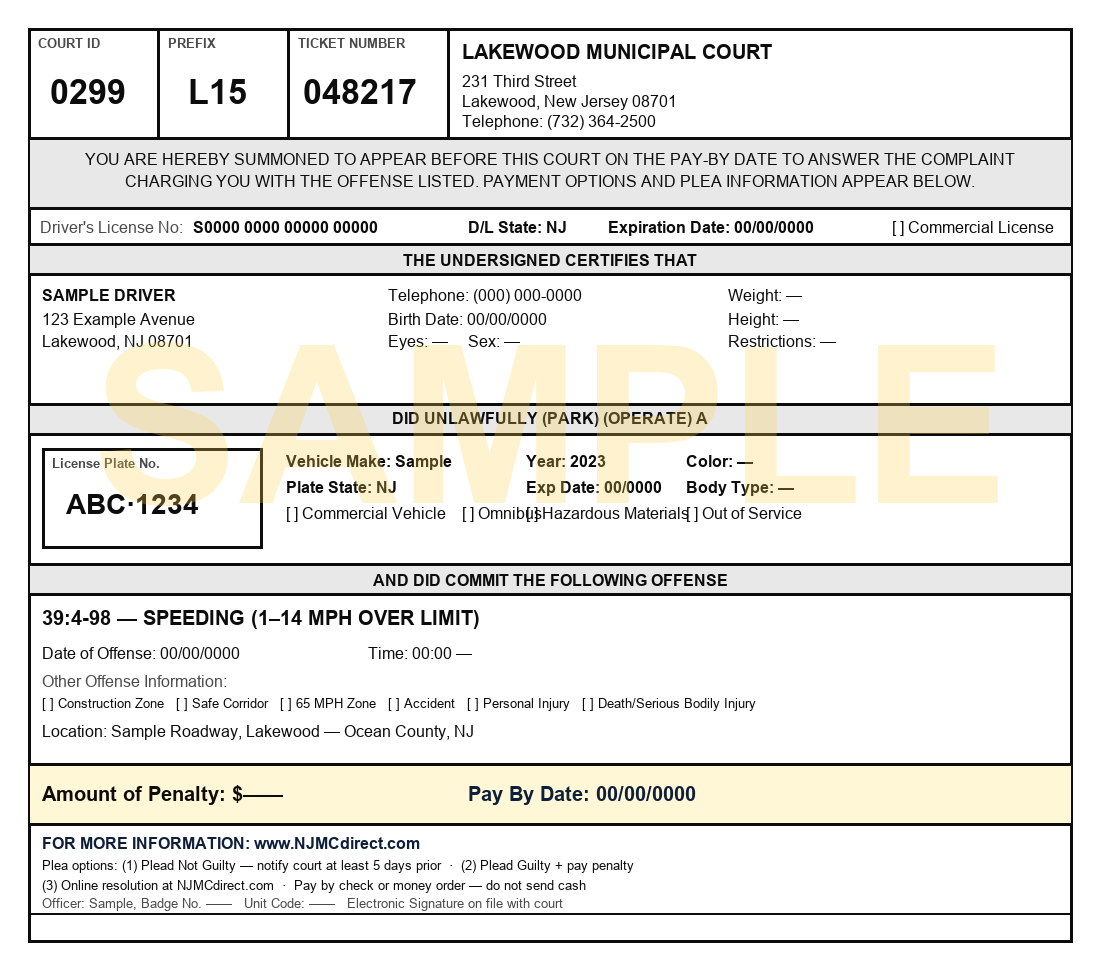
Failure to yield at an intersection in New Jersey carries 2 points under N.J.S.A. 39:4-90. It’s often written after a collision and is commonly negotiable to no points.
Points for Failure to Yield in NJ
| Violation | License Points |
|---|---|
| Failure to yield at intersection (39:4-90) | 2 points |
Point values from the official New Jersey MVC point schedule. New Jersey adds points to your license when you’re convicted — and paying a ticket by mail counts as a guilty plea.
What N.J.S.A. 39:4-90 Actually Covers
N.J.S.A. 39:4-90 sets the right-of-way rules at intersections. Like other intersection tickets, it's frequently issued after a crash the officer didn't witness, based on the position of the vehicles and the drivers' accounts. That makes the State's proof contestable and the ticket a candidate for a downgrade.
Why the Points Matter
Points stack across tickets and follow you. In New Jersey, reaching 6 points on your record within three years triggers an annual state surcharge, and 12 points triggers a license suspension. Points can also raise your insurance for years. You can knock 3 points off after a year with no violations, and 2 more by completing an approved driver-improvement course — but the conviction itself stays on your history. That’s why keeping points off in the first place is almost always cheaper than paying the ticket and dealing with the fallout.
Can You Beat Failure to Yield?
The goal with a failure-to-yield ticket is usually to keep the 2 points off your record. When the ticket follows an accident, the proof can be thin, and a no-point downgrade is often achievable depending on your history. If you were injured in the crash, we can look at the injury claim alongside the ticket.
Frequently Asked Questions
How many points is failure to yield in NJ?
Failure to yield at an intersection under N.J.S.A. 39:4-90 is a 2-point offense in New Jersey.
I got a failure to yield ticket after an accident — can I fight it?
Often, yes. When the officer didn't see the crash, the proof relies on after-the-fact reconstruction, which can be challenged. The goal is usually a no-point resolution.
Can failure to yield be downgraded?
Frequently — a no-point downgrade is a common goal, depending on your record and the facts. A free review will tell you what's realistic.
Related: use the free NJ traffic points calculator to total your points, or read more about fighting a New Jersey traffic ticket. This page is general information, not legal advice — every case turns on its own facts, and prior results don’t guarantee a similar outcome.
Cited for the turn itself — or for not signaling it? See our NJ failure to signal guide (N.J.S.A. 39:4-126) for how that companion charge works and why officers often write both.