







Failure to Maintain Lane in NJ — N.J.S.A. 39:4-88(b)
An officer writes a failure to maintain lane ticket when they believe your car drifted over a lane line. On its own it is a two-point moving violation. Attached to a DUI, it is often the stated reason for the stop, and the doorway to the whole case. Goldman Law Firm defends these tickets throughout New Jersey as part of our NJ traffic ticket defense practice. Free consultation, 24/7. Call or text 908-692-7745.
What the Lane Statute Actually Requires
N.J.S.A. 39:4-88(b) puts two duties on a driver: drive “as nearly as practicable entirely within a single lane,” and do not leave that lane until you have made sure the move is safe. Most tickets are written on the first duty: a tire crossed the line or the car straddled two lanes. A conviction adds 2 points. The words that matter are “as nearly as practicable.” The Legislature did not write “at all times,” and the State has to prove your departure was one the law does not excuse.
Why a Two-Point Ticket Carries So Much Weight in a DUI Case
An officer cannot stop a car on a hunch. New Jersey law requires a reasonable, articulable suspicion that a motor vehicle law was being broken: a specific observation the officer can describe. Lane drift is the stated reason for many DUI stops because it can be described in one sentence and fits the story of an impaired driver. If the drift did not happen, or what the officer saw was too slight to suggest a violation, the stop had no lawful basis, and everything that followed it, from the field sobriety tests to the breath test, can be suppressed. A reason in the road the officer could not see, a deer or a pothole, defends the ticket itself rather than the stop. A DUI defense often starts right here.
How the Lane Observation Is Tested When It Is the Only Basis for the Stop
When lane drift is the sole reason for the stop, we file a motion to suppress, and the court holds a hearing where the State must put the officer on the stand and prove the observation. We cross-examine on the details that decide whether it was real and whether it rose to a violation:
- How far over, how many times, over what distance. One tire touching the line once on a dark highway is not a car crossing into the next lane three times in a few hundred feet.
- Where the officer was. Following distance, angle of view, headlights, rain on the windshield, eyes on your lane or on the computer screen.
- What the road looked like. Faded markings, construction shifts, a merge that narrows, a curve where the line itself bends.
- Whether the video agrees. A camera that shows a steady car gives the officer’s description a credibility problem the court can see for itself.
What the Officer’s Report and the Video Must Actually Show
We request the full record in discovery before your first court date. Most New Jersey patrol cars record through a mobile video recorder, and state law now requires uniformed patrol officers to wear body-worn cameras. We compare the officer’s written description against the footage: the time stamp of the alleged drift, the moment the overhead lights come on, and what the officer says at your window. If the video is missing, was not preserved, or starts after the drift supposedly happened, that is the State’s problem to explain, not yours.
Lane Departures the Law Allows
Because the statute reads “as nearly as practicable,” a departure with a good reason is the kind of departure the statute allows. The reasons we argue on Ocean and Monmouth County roads:
- Debris and potholes. A tire carcass, a ladder off a work truck, a winter pothole on Route 9.
- Animals. Deer along Route 70 and Route 72, especially at night.
- Wind. Crosswinds on the causeways and bridges to the barrier islands.
- A lane obstruction. A disabled vehicle, cones, a mail truck half in the lane.
- An emergency vehicle. New Jersey’s Move Over law requires you to change lanes, or slow down, for stopped emergency, tow and roadside service vehicles.
- Cyclists and pedestrians. The safe passing law requires you to give room, and moving over to do it is not what the statute is aimed at.
Your memory of the road that night is evidence. Tell us what you were avoiding and where, and we look for corroboration in the video, the weather and road-work records.
Failure to Maintain Lane Compared With Careless Driving
Officers often write a lane ticket and a careless driving ticket for the same moment. Failure to maintain lane is specific: one act, the car leaving its lane. Careless driving under N.J.S.A. 39:4-97 is broad: driving without due caution in a way that endangers, or is likely to endanger, a person or property. Both carry 2 points. Charging both gives us two tickets to argue about; which one survives, and in what form, is the negotiation.
The Standalone Ticket and the Downgrade That Removes the Points
When the lane ticket stands alone, the usual goal is a downgrade to a violation that carries no points. The common landing spot is unsafe operation of a motor vehicle, N.J.S.A. 39:4-97.2, a violation that carries a state surcharge instead of points for a first or second conviction within five years; a third within five years carries points, so it is a plea we use carefully. Where the video is weak or the road excused the drift, we ask for an outright dismissal. What you should not do is pay the ticket. Paying is a guilty plea: the points post and the chance to fight is gone. The plea-by-mail mistake is the easiest one to avoid.
Points, the Surcharge and Your Insurance, in Plain Words
Reach 6 or more points within three years and the Motor Vehicle Commission bills you a surcharge every year for three years. Reach 12 points and the MVC suspends your license. The MVC subtracts 3 points for every full year without a violation or suspension, though the conviction stays on your abstract. New Jersey insurance carriers keep their own point schedules, and a moving violation can move you into a higher rate tier at renewal and hold you there for several years. For the full picture, read how the NJ point system works.
Commercial Drivers and Out-of-State Drivers
If you hold a CDL, an erratic lane change in a commercial vehicle counts as a serious traffic violation under federal rules, and two within three years disqualify a CDL. If you live outside New Jersey, the conviction is reported to your home state, which applies its own rules.
Where the Ticket Is Heard and Whether You Have to Be There
The ticket is heard in the municipal court of the town where the stop happened, including Parkway and Turnpike stops by the State Police. We appear in municipal courts across Ocean and Monmouth Counties and throughout the state. For many standalone tickets we can appear on your behalf, so you do not lose a day of work. When the lane ticket is attached to a DUI, you need to be there, and we are there with you.
The Court Date on Your Ticket and Why the Clock Matters
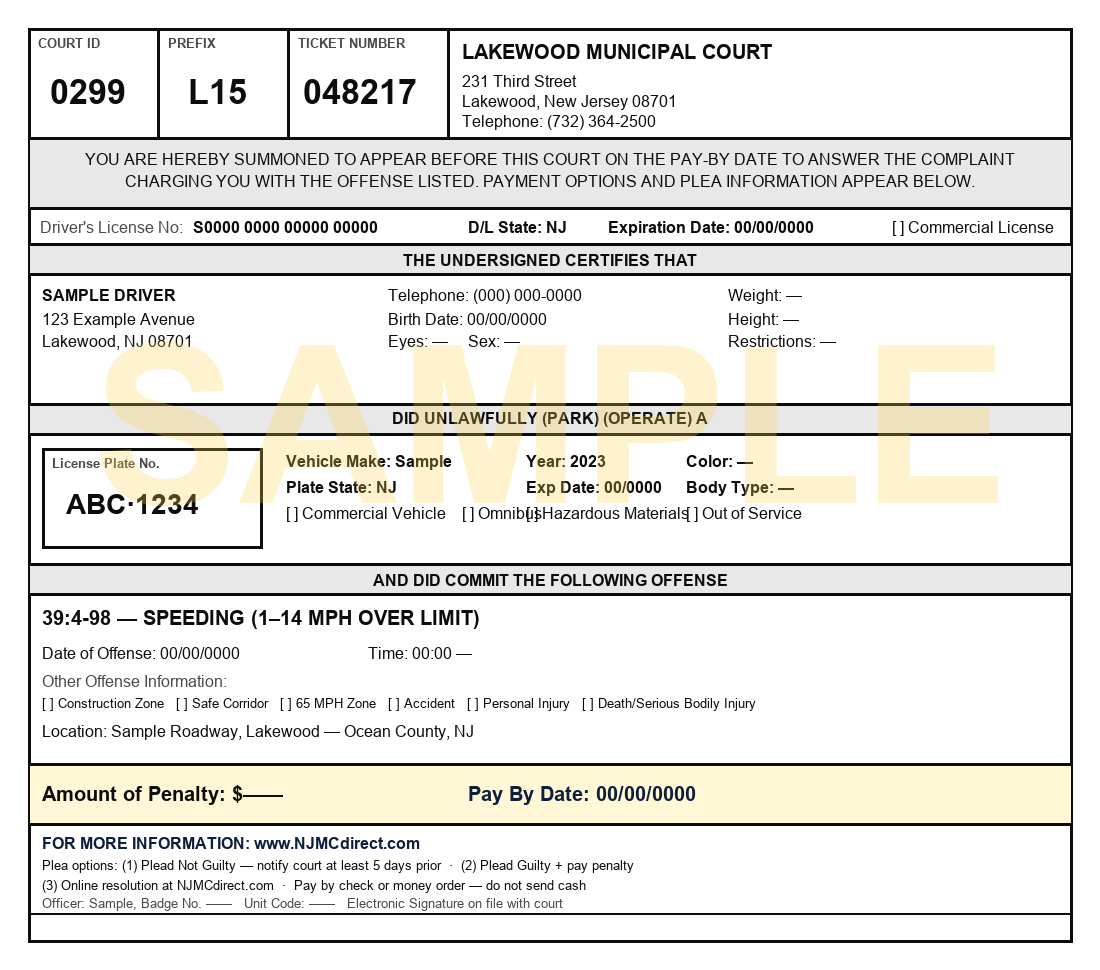
Your summons lists a court date, usually a few weeks out. Do not wait for it. Contact us as soon as you have the ticket so we can enter our appearance and request the video and the officer’s report. If the summons says a court appearance is required, that is not optional, and missing the date can lead to a warrant or a license suspension.
What to Bring to the Free Consultation
- The summons and every other ticket from the same stop.
- Your account of the road: what you were avoiding, the weather, the lighting, how far back the patrol car was.
- Names of any passengers.
- Your own dash-cam footage, or your phone if it recorded the stop.
- Your MVC driver history abstract if you have one.
- Your CDL, if you hold one, and your home state, if it is not New Jersey.
What Hiring Goldman Law Firm Looks Like
We review the ticket for free and tell you which case you have: a standalone lane ticket where the goal is a no-point downgrade or a dismissal, or the front end of a DUI where the lane observation is the whole fight. Fees for a standalone municipal ticket are flat and quoted in the consultation. Call or text 908-692-7745, any hour, or upload a photo of the ticket for a free ticket review.