







Charged With Driving While Suspended in Lakewood? Don’t Plead Guilty at the Window
Driving while suspended — N.J.S.A. 39:3-40 — is the most underestimated charge in municipal court. People treat it like a ticket, plead guilty to get it over with, and walk out with a longer suspension, escalating fines, and a record that makes the next stop dramatically worse — including real jail exposure. It is also one of the most defendable charges we handle. Goldman Law Firm defends 39:3-40 cases in Lakewood and throughout Ocean County for a flat fee, explained upfront. Start with a free consultation: send us your summons or call/text 908-692-7745, 24/7.
How These Charges Start in Lakewood
Almost every Lakewood driving-while-suspended case starts as something smaller. A stop on Route 9 for a cell phone in hand, a burned-out taillight on Route 88, a speed clock on Route 70 — and then the license check comes back suspended. Lakewood’s police department is one of the busiest in Ocean County and its corridors are patrolled constantly, so a suspended driver here isn’t running an occasional risk; every trip through town crosses an enforcement zone.
What makes Lakewood’s docket distinctive is how many of these drivers had no idea they were suspended. Lakewood is a town of working commuters and large families, addresses change, and an MVC notice mailed to an apartment you left two years ago never reaches you. An unpaid surcharge or an insurance lapse quietly becomes a suspension, and the first time you hear about it is on the side of Route 9 — now with a charge that carries jail exposure attached.
Your Case Is Heard at Lakewood Township Municipal Court — and the Ladder Gets Steep
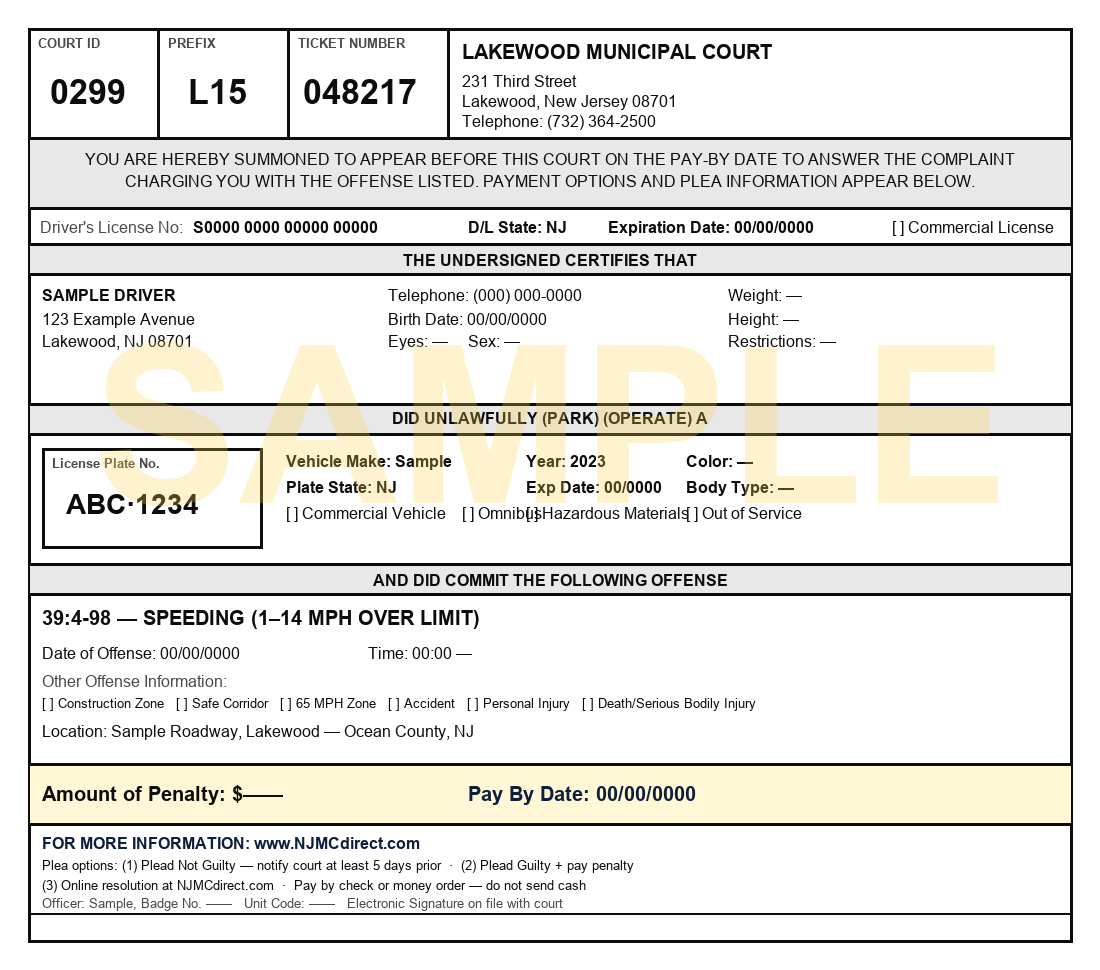
Ordinary 39:3-40 charges from Lakewood are heard at Lakewood Township Municipal Court, 231 Third Street, Lakewood, NJ 08701 — a court we appear in regularly. The statute escalates with each conviction: a first offense brings a statutory fine and up to six more months of suspension on top of what you already had, with jail possible but uncommon absent aggravating factors. A second offense adds a steeper fine and one to five days of county jail that courts can and do impose. A third or subsequent offense means up to ten days in jail plus the added suspension. And if you were suspended in a school zone or caused an accident while suspended, the exposure climbs again. The full grid is in our 39:3-40 penalties guide — and the reason to fight a first offense is sitting right there in the ladder: every later charge is priced off the ones before it.
When It Stops Being a Traffic Case: N.J.S.A. 2C:40-26
The most dangerous version of this charge isn’t heard in Lakewood at all. If your license was suspended for DWI or breath-test refusal and you drove anyway, the State can charge N.J.S.A. 2C:40-26 — a fourth-degree indictable crime sent to the Ocean County Superior Court in Toms River, carrying up to 18 months of state prison time with a 180-day mandatory minimum and no probation around it. That is not a case to “explain to the judge” on your own, and it is not one where a quick guilty plea limits the damage — the mandatory minimum removes that option. If your suspension traces back to a DWI or refusal, call us before you say anything to anyone: 908-692-7745.
The Notice Defense: The State Has to Prove You Knew
Here is the part most Lakewood defendants never hear before pleading guilty: the State must prove you knew, or reasonably should have known, your license was suspended. MVC suspension notices go by mail to your address of record — and they get lost, sent to old addresses, or never mailed correctly at all. If you moved and the paper trail shows the notice went to an address you’d left, the State’s case can collapse on that element alone. This is why we tell every client the same thing before the first court date: pull together your address history — leases, utility bills, anything dated — because it is often the single most valuable piece of the defense. The stop itself gets scrutiny too: if the officer had no lawful basis to pull you over, what followed the stop may be suppressed. More in our guide to the notice defense.
Read Your Driver History Before You Walk Into Court
The single most useful document in a Lakewood 39:3-40 case is your MVC driver history abstract. It shows why you were suspended, when the suspension took effect, what notices the MVC generated, and what has to happen before you can be restored. Defendants who plead guilty at the first appearance almost never got that far — they’re pleading to a charge without knowing what the State’s own paperwork says about it. We pull and read the abstract before your court date, because it answers the two questions the whole case turns on: was the suspension itself valid, and can the notice element actually be proven. More than once, the abstract has shown a suspension that shouldn’t have been on the books at all.
The Charge Rarely Travels Alone
A 39:3-40 summons usually arrives with company: the ticket that caused the stop — speeding, a cell phone, an equipment violation — and often a companion charge like driving without insurance, since a lapsed policy is one of the most common reasons a license was suspended in the first place. Those companion charges are not side issues. Driving without insurance carries its own suspension and surcharge consequences that can exceed the 39:3-40 exposure, and the package has to be negotiated as a package — resolving one charge in a way that torpedoes the defense to another is the classic self-represented mistake. Bring every summons from the stop to the consultation, not just the suspended-license one.
Fix the License First — It Changes Everything
A large share of Lakewood suspensions are administrative: unpaid MVC surcharges, an insurance lapse, a missed payment plan, a ticket in another town that became a failure-to-appear. Those suspensions can usually be cured — and walking into court with a restored, valid license puts the whole case in a different posture than walking in still suspended. Restoration doesn’t erase the charge, but it fixes the problem the charge is built on, opens negotiating room, and stops the snowball from rolling into a second offense. We run both tracks at once: restoration with the MVC, defense in the courtroom. Step-by-step in our license restoration guide.
What We Do With a Lakewood 39:3-40 Case
First, we find out why you were suspended — because everything flows from that answer: an administrative suspension is a fixable paperwork problem, a point-based suspension needs a different strategy, and a DWI-based suspension means we’re defending an indictable case, not a ticket. Then we test notice, test the stop, and negotiate from whatever leverage those produce. First-offense cases can sometimes resolve in ways that protect both your record and your wallet — but only if they’re worked, not pleaded at the first appearance. Fees are flat, set by the type of case, and quoted at the free consultation before you decide anything: 908-692-7745.
Related Lakewood Defense
- NJ driving while suspended defense — the statewide guide
- 39:3-40 penalties: first, second, and third offense
- Does driving while suspended carry points?
- How to restore a suspended NJ license
- Ocean County traffic ticket lawyer
- Traffic ticket lawyer in Lakewood — every charge, not just 39:3-40
- All Lakewood legal services
- Driving while suspended lawyer in Toms River
- Driving while suspended lawyer in Brick
- Driving while suspended lawyer in Jackson